Grounded response
Managing Sudden Emotional Shifts During Heart Chakra Activations
Moldavite often arrives with large words around it: opening, release, activation, transformation. The grounded answer is quieter. If sudden emotional shifts arise during what you call a Somatic Heart Chakra Release, pause the session, orient to the room, name the feeling in plain words, lower the intensity, and avoid deciding too quickly what the experience means.
You can keep a spiritual framework without treating it as proof that a chakra event, suppressed emotional release, or body-based clearing is definitely happening. If the emotion feels intense but manageable, treat it as a signal to slow down. If symptoms feel unsafe, frightening, persistent, chest-related, self-harm-related, or overwhelming in a trauma-linked way, step out of the practice and seek qualified support or urgent care when relevant.
Meaning can wait. Safety comes first.

broader context
Start with the main moldavite page
This narrower page makes more sense after the broader moldavite archive page.
Start by Reducing the Intensity
Sudden emotional shifts often pull the mind toward interpretation. In a heart chakra activation lens, sadness may be read as grief leaving, warmth as opening, and restlessness as energy moving. Those interpretations may be personally meaningful, but they are not the first task when the experience is sharp.
The first task is to reduce intensity enough that you can choose what to do next.
A short reset
- Put the moldavite or ritual object down if you are holding one.
- Open your eyes and look at ordinary objects in the room.
- Feel your feet, chair, blanket, or floor.
- Let your breath return to a normal rhythm instead of forcing a special pattern.
- Say one plain sentence: “I am feeling sadness,” “I am feeling fear,” or “This feels like too much.”
This is not a claim that grounding changes a verified mechanism. It is a low-pressure way to interrupt escalation and return attention to the present moment.
Naming the feeling matters because it keeps the experience from becoming a myth before it becomes understandable. “I feel grief” is easier to work with than “my heart chakra is purging every old wound.” The second sentence may fit your spiritual language later; the first helps you stay here now.
Keep the Spiritual Frame Optional
A Somatic Heart Chakra Release is usually described in spiritual or energy-work language. Some readers use it for crying, chest-centered emotion, tenderness, old memories, or a sudden wave of love or loss. The available material for this page does not verify that these experiences prove a chakra activation, a nervous-system event, trauma clearing, or heart-brain coherence. Those phrases can be part of meaning-making, not the whole evidence.
That distinction protects the experience from both dismissal and exaggeration.
You do not have to reject your spiritual framework to be careful. You can say, “I interpret this as heart-centered work,” while also saying, “I do not know exactly what is happening in my body.” That is a cleaner boundary than forcing certainty.
The same applies to suppressed emotional release. Some people use that phrase when emotion appears suddenly after being held back, avoided, or unnamed. It may describe how the moment feels. It should not be treated as a confirmed explanation for every wave of crying, pressure, shaking, or panic.
Moldavite symbolism can make this especially tempting. Because the stone is often surrounded by transformation language, a difficult moment may feel like evidence that the specimen is doing something decisive. A more careful reading leaves room for object, setting, expectation, personal history, and symbolic meaning, while the exact cause remains uncertain.
A Practical Sequence for Managing Sudden Emotions
When emotions move quickly, a simple order helps more than a complex ritual. Use this as reflective guidance, not as a rule every person must follow.
Pause
Stop adding stimulation. Put down the stone, close the journal, pause the music, or step away from the meditation. If the practice seems to be increasing distress, continuing just to “finish the release” can make the moment harder to evaluate.
Ground
Choose one ordinary anchor. A glass of water, a textured blanket, a familiar wall, or the feeling of shoes on the floor can bring attention back to observable reality. Do not turn grounding into another performance. Simple is enough.
Name the feeling
Use emotional words before spiritual labels. Try “sad,” “angry,” “lonely,” “afraid,” “tender,” “numb,” or “confused.” If you cannot name it, say, “Something is moving, and I do not need to solve it yet.”
Reduce the charge
Lower lights if they are harsh. Sit instead of standing. Stop breathwork if it feels forceful. Step away from intense music, incense, heat, cold exposure, or any practice that makes the emotion feel less manageable.
Choose the next container
You may write two or three sentences, speak to a trusted person, rest, eat something simple, or end the session. The goal is not to extract a perfect lesson. The goal is gentle integration.
This sequence leaves room for spiritual meaning without demanding it. It also avoids turning every sensation into a message.
Common Confusion Around “Release” Language
The word “release” can be useful when it gives someone permission to stop fighting an emotion. It becomes less useful when it turns distress into an obligation.
Confusing intensity with necessity
One common confusion is the idea that a sudden wave must be endured because it is the “labor pains of energy work.” As a metaphor, that phrase may express how intense a process feels. As a rule, it is risky language. Pain, fear, panic, chest symptoms, or trauma-overwhelming states should not be romanticized as necessary proof that the work is succeeding.
Confusing strength with truth
Another confusion is assuming that stronger emotion means deeper activation. A quiet realization may be meaningful. A dramatic cry may be meaningful. Neither one proves more spiritual progress than the other. Intensity is not the same as truth.
Confusing wellness language with verification
A third confusion is using heart-brain coherence language as if it verifies what is happening during a heart chakra activation. Some wellness circles use that phrase to describe harmony, connection, or centeredness. In this page’s evidence set, it should remain reader-language, not a confirmed explanation for sudden emotional shifts.
The safest interpretive pattern is modest: “This felt heart-centered to me, and I will respond with care.” That gives the experience dignity without turning it into certainty.
When to Stop the Practice
A heart chakra frame should never make you ignore body-safety boundaries. Stop the practice if the experience feels beyond your ability to stay oriented, if you feel afraid of what you might do, or if the sensations are medically concerning. This includes intense or persistent chest-related symptoms, faintness, severe panic, self-harm thoughts, or trauma memories that feel uncontainable.
If the situation feels urgent, use emergency support available where you are. If it is not urgent but continues to trouble you, consider reaching out to an appropriate qualified professional, especially if the emotions are recurring, disruptive, or tied to past harm.
This boundary is not anti-spiritual. It is part of responsible spiritual practice.
A moldavite ritual, meditation, or reflective session can be meaningful without being the right container for every emotional state. Some moments ask for rest. Some ask for companionship. Some ask for trained support. The presence of spiritual symbolism does not remove those ordinary needs.
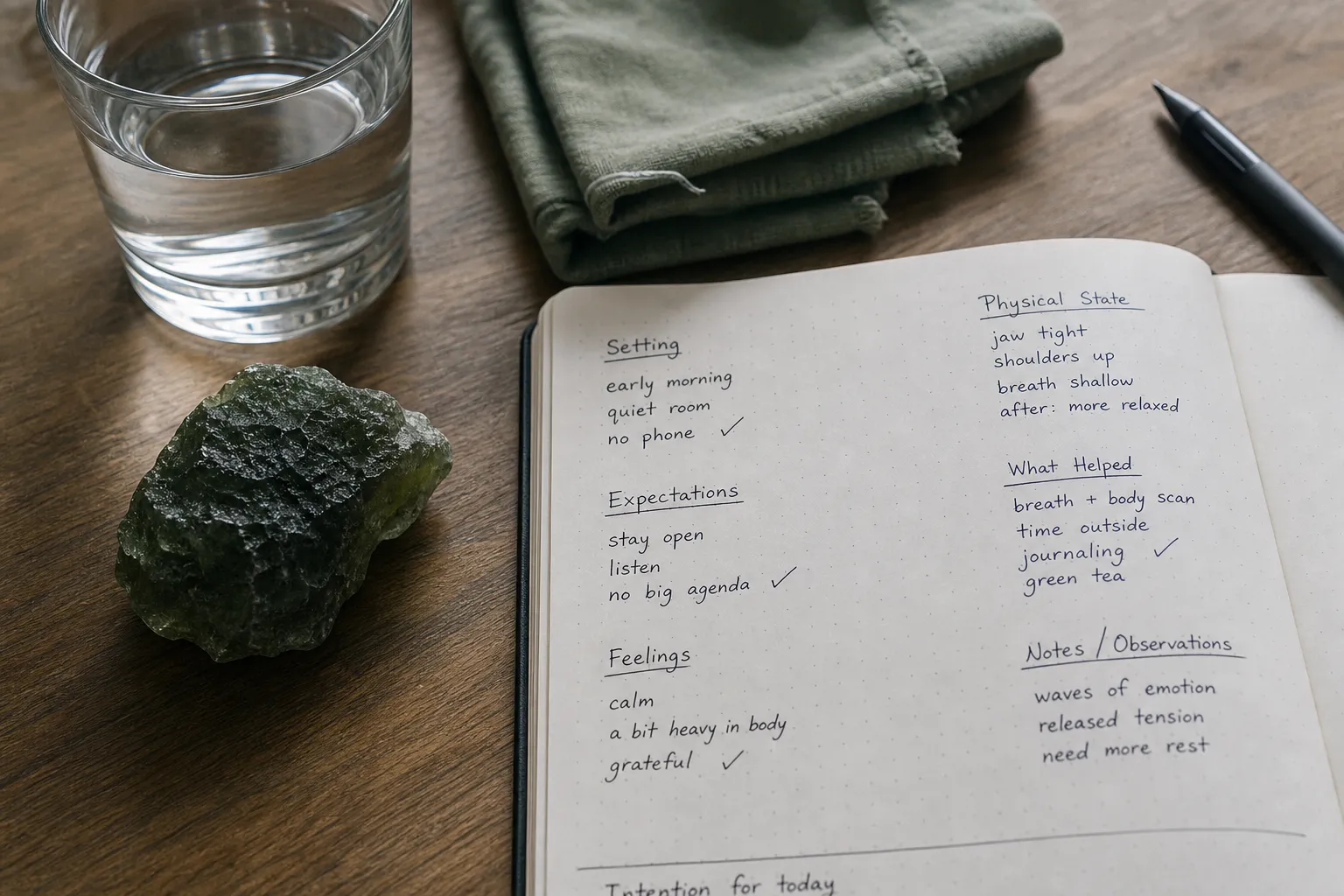
Integrate Without Over-Interpreting
After the intensity drops, do not rush to assign a final meaning. Integration is often gentler when the question is small.
Questions to ask afterward
- What did I feel, in ordinary emotional language?
- What was happening before the shift started?
- Did anything in the setting increase intensity?
- What helped me feel more oriented?
- Is there any part of this I should discuss with someone supportive?
If you use moldavite as part of the practice, include it in the record without making it the whole explanation. Note the stone, the time, the setting, your expectations, and your physical state. Collector literacy and spiritual restraint can live together here: the specimen may carry symbolic meaning for you, but the page evidence does not support treating it as a guaranteed cause of emotional change.
Gentle integration may look like closing the session, putting the stone away, stepping outside, eating, sleeping, or writing one grounded paragraph. It may also mean deciding not to repeat the same practice for a while. That is not failure. It is discernment.
The most useful conclusion is rarely dramatic. Something moved. You slowed down. You kept meaning separate from proof. That is enough for one session.
The Boundary This Page Can Support
This page can support a careful response to sudden emotional shifts during a Somatic Heart Chakra Release: pause and ground, name the feeling, reduce intensity, avoid over-interpreting, and seek help when symptoms feel unsafe. It can also acknowledge that some readers use heart chakra activation language to frame emotional tenderness, grief, love, or release.
It cannot verify that a chakra opened, that suppressed emotion was cleared, that moldavite caused the shift, or that a specific body mechanism occurred. The supplied research set for this page included no citable public sources for those claims, so they remain spiritual interpretation and reader language.
That boundary does not make your experience meaningless. It simply keeps the meaning honest. In moldavite work, as in any intense symbolic practice, the stronger path is not certainty at any cost; it is attention, restraint, and care for the body you are actually in.