Grounding grid practice
The Grounding Grid: Pairing Tektites with Smoky Quartz and Tourmaline
A Moldavite grounding grid works best as a symbolic layout, not as a technical or health-based system. Place Moldavite, or another tektite, at the center; use smoky quartz close around it as the earthy counterbalance; and set black tourmaline at the outer points to mark the edge of the practice. In crystal-practice language, this is often called Synergistic vibration buffering—a useful metaphor for pacing the ritual, not a measured physical process.
The direct answer is simple: keep the tektite central, make the grounding stones larger or more numerous, and keep the first session short. Geology can describe Moldavite as impact-formed natural glass. It cannot prove that a grid changes health, sleep, mood, protection, or life outcomes.
broader context
Moldavite context note
This narrower page makes more sense after the broader moldavite archive page.
Direct layout
- Center: one Moldavite piece or another tektite.
- Close ring: smoky quartz as the visual and tactile counterbalance.
- Outer edge: black tourmaline to mark the boundary of the practice.
- Limit: symbolic pacing, not proof of energetic or health effects.
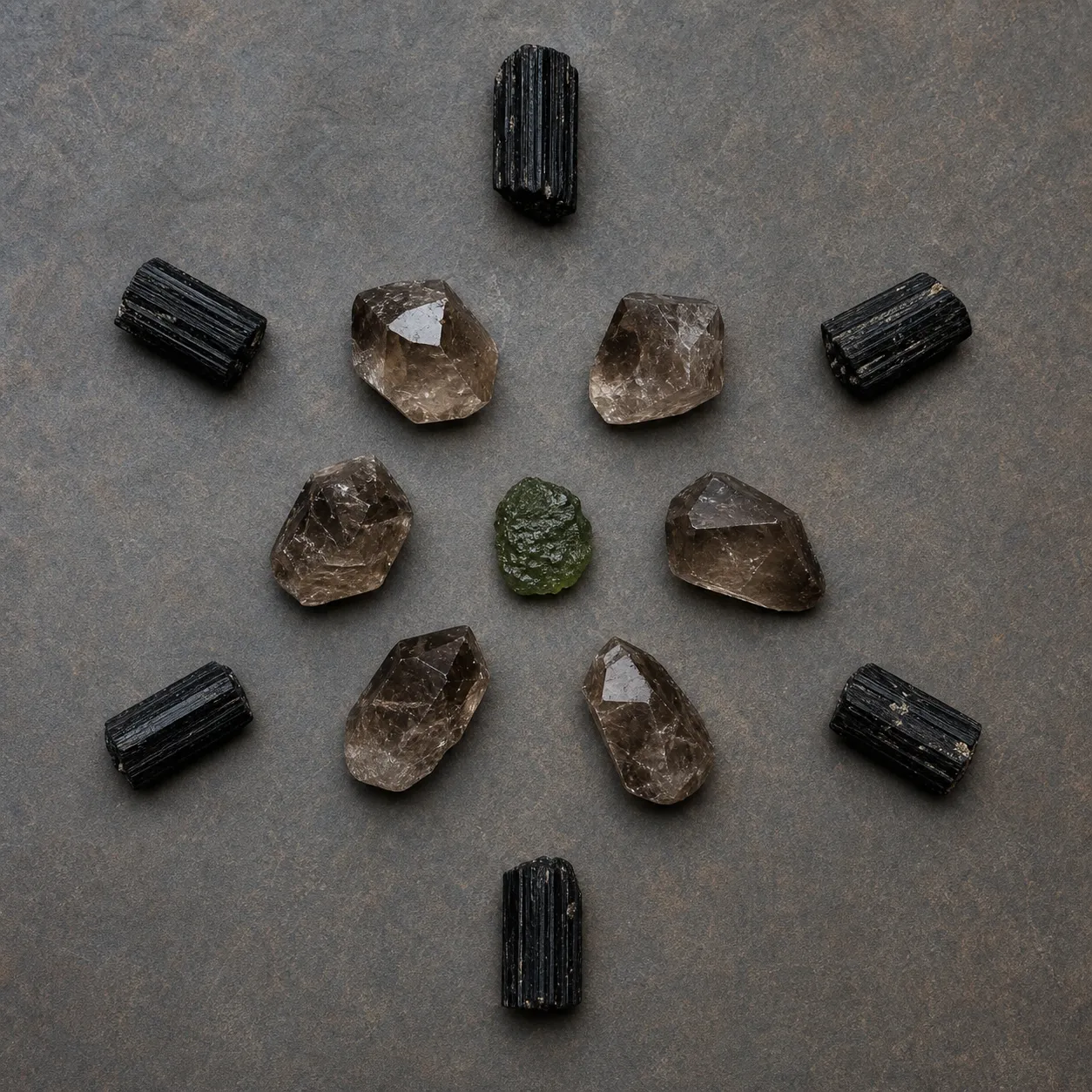
The Core Layout
Moldavite is a green natural glass and a type of tektite, associated with an ancient meteorite-impact event roughly 15 million years ago. It is not a conventional crystalline mineral, and it is not a literal meteorite. That distinction matters because pairing language can slide too quickly from material identity into energetic certainty.
For this grid, treat the Moldavite or tektite as the impact point of the layout. It sits in the middle because the practice is organized around the intensity many practitioners associate with Moldavite. That does not prove the same response for everyone; it only reflects the way the material is commonly discussed in Moldavite circles.
Smoky quartz belongs close to the center. Its brown, gray, or smoky tone gives the arrangement a quieter visual weight, so it can act as a tactile cue to slow the session down. Black tourmaline works better at the perimeter: four corners, a loose ring, or the side closest to the body. In this context, “protection” means boundary-making in the ritual design, not literal shielding.
A restrained starting layout
- Center: one Moldavite piece or another tektite.
- Middle ring: three or four smoky quartz pieces.
- Outer points: black tourmaline at the corners or cardinal directions.
- Adjustment: move the Moldavite farther away if the practice feels too intense.
- Session length: begin with a few minutes, not a long ritual.
“Shock-absorption grounding” is only a metaphor here. Smoky quartz and black tourmaline are not absorbing measurable energetic shock. They are physical grounding crystals in the ordinary sense: objects that help structure attention, touch, pacing, and intention.
Why Smoky Quartz and Black Tourmaline Play Different Roles
Smoky quartz and black tourmaline often appear together in grounding language, but they do not need to do the same job.
Smoky quartz as buffer
Smoky quartz is the softer buffer in this layout. If the Moldavite smoky quartz pairing has practical value, it is in the way it changes the rhythm of the ritual. The eye moves from green impact glass to darker, clouded quartz; the hand has more than one texture to return to; the practice becomes less centered on intensity alone.
Black tourmaline as edge
Black tourmaline is better treated as an edge or anchor. The Moldavite black tourmaline pairing carries mixed advice in community spaces. Some readers see it as the obvious grounding partner. Others find the combination too heavy, too sharp, or simply not comfortable.
Those reports are not strong evidence either way, but they are useful reminders not to turn one layout into a universal rule.
Keep the grid adjustable. If tektites with black tourmaline feel too severe, increase the smoky quartz and reduce the tourmaline points. If the layout feels scattered, keep black tourmaline only at the corners and remove extra stones. If Moldavite feels too central, use a smaller piece, place it slightly above the grid’s center, or substitute another tektite with less personal charge.
The phrase “high-density earth minerals” appears in grounding conversations because dark, heavy-looking stones can feel visually anchored. Use that idea carefully. Black tourmaline is a mineral, smoky quartz is a quartz variety, and Moldavite is natural glass. Their color, density, or category does not establish a health or emotional effect. Here, density is a symbolic design cue.
The best grid is not the most forceful grid. It is the one that gives the tektite enough space while making the practice feel paced, bounded, and easy to stop.
What Changes the Answer
The Moldavite piece matters
A large specimen, a sharp pendant, and a small chip create different tactile experiences. A collector may care about surface texture, locality claims, and provenance; a spiritual practitioner may care about how the piece feels during a ritual. Keep those categories separate. Specimen traits help with collector literacy. They do not verify energetic claims.
The purpose of the session matters
If the grid is for display, symmetry and visibility may matter most. If it is for meditation or journaling, distance from the body, session length, and the ability to pause matter more. Physical grounding here means embodied attention: noticing the weight of a stone, the surface beneath your hands, the placement of objects, and the rhythm of beginning and ending.
Personal response matters
Some practitioners describe Moldavite as intense, floaty, fast, or overwhelming. Those descriptions are common in the niche, but they remain subjective. If the practice feels unpleasant, do not force it as a sign of transformation. Shorten the session, move the Moldavite farther away, use only smoky quartz for a while, or stop. If panic, sleep disruption, persistent distress, or health symptoms are involved, use appropriate licensed care rather than relying on stones.
The exact tektite matters less than the boundary
A grid with Moldavite carries a specific collector and symbolic charge because Moldavite is a named Central European tektite material. A grid with another tektite can use the same structure—impact glass at the center, darker grounding stones around it—but it should not borrow Moldavite origin claims. That is the Moldavite origin boundary: use the name Moldavite only when specimen identity and provenance language support it.
Finally, more stones do not make the grid more grounded. Too many pieces can create too many meanings and too much interpretive pressure. For this single grid, three roles are enough: tektite as the focus, smoky quartz as the buffer, black tourmaline as the edge.
Common Confusion Around “Vibration Buffering”
The main confusion is treating tektite vibration buffering as if it were a physical mechanism. In ordinary language, buffering suggests insulation, reduction, or measurable impact control. That is not what this phrase can support.
Boundary note
“Synergistic vibration buffering” belongs to crystal-practice vocabulary. It describes how some practitioners arrange stones so the session feels less abrupt or less centered on Moldavite intensity. It does not show that smoky quartz or black tourmaline changes a measurable field around Moldavite. It does not make the grid a safety instrument.
Another confusion is calling Moldavite a crystal in the same sense as quartz or tourmaline. Moldavite is widely discussed in crystal communities, but physically it is natural glass formed through impact processes. Quartz and tourmaline are crystalline minerals. That difference does not make Moldavite less meaningful; it keeps the geology accurate.
Protection language also needs care. Black tourmaline is often marketed as a protection stone, and many readers use that vocabulary sincerely. For this page, translate protection into practice design: set limits, mark an edge, avoid overlong sessions, and do not treat discomfort as a requirement. The stone can symbolize a boundary. The boundary is enacted by the person.
There is also a folk belief that stones break, crack, or feel “full” because they have taken on unwanted energy. The available material does not support presenting that as fact. Stones can chip, fracture, or break for ordinary physical reasons. Inspect the object first before building a spiritual conclusion around it.
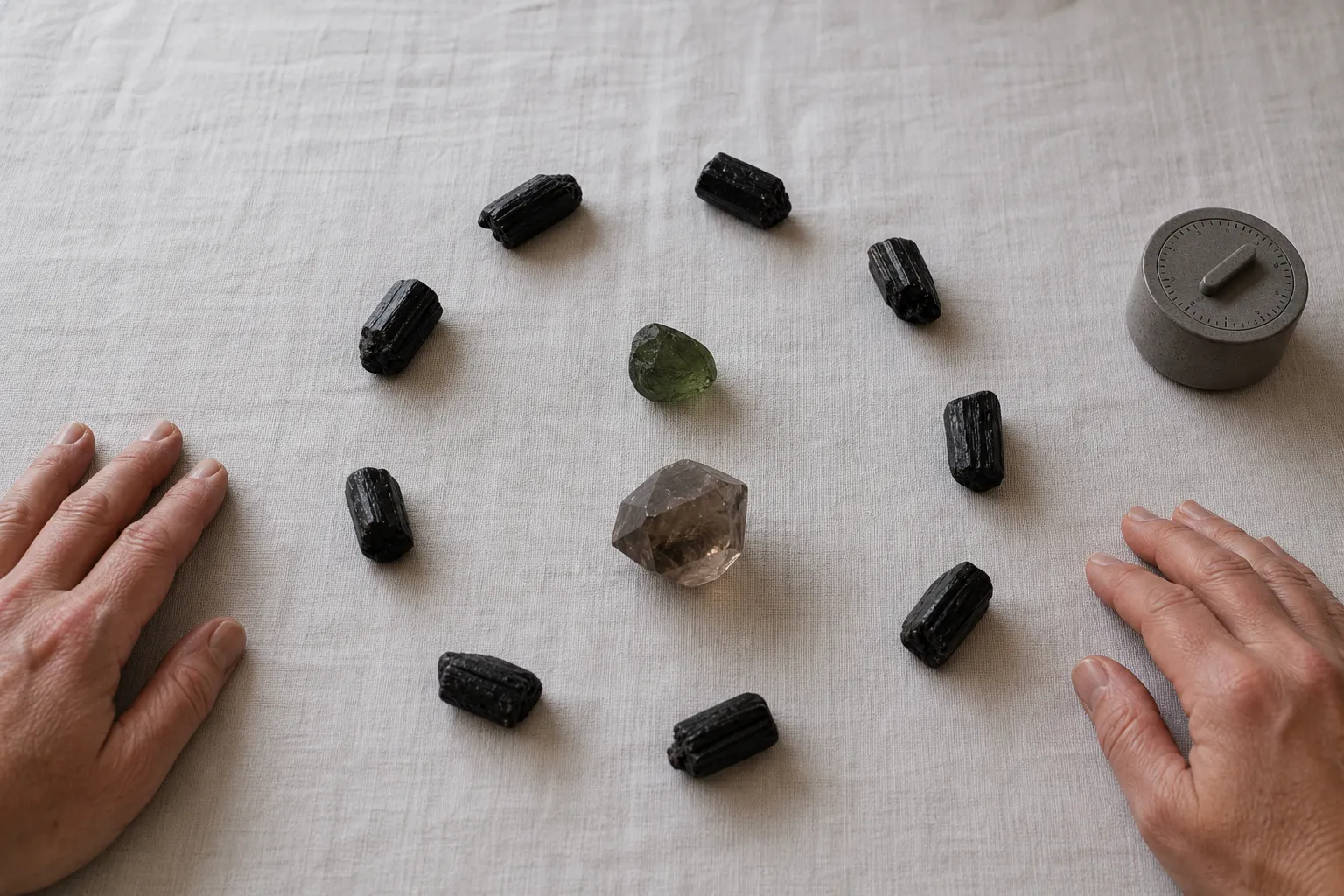
A Cautious Five-Minute Grid
- 1. Set the center and rings.
Set one Moldavite or tektite piece in the center. Place three smoky quartz stones in a loose triangle around it, leaving enough empty space that the center does not feel crowded. Add four black tourmaline pieces outside that triangle, or use one piece below the grid as a single anchor point. Sit where you can see the whole layout without holding the Moldavite continuously.
- 2. Name the purpose plainly.
Before beginning, name the purpose in plain terms: “I am using this layout to slow down and stay present.” That wording keeps the practice grounded in attention rather than a promised result. Rest your hands on the table, floor, or cloth near the outer stones. Notice contact, texture, temperature, and distance. If you use breath as part of the ritual, keep it ordinary and unforced.
- 3. Close the session deliberately.
After a few minutes, close the session deliberately. Move the Moldavite away first, then the smoky quartz, then the black tourmaline. This reverse order gives the ritual a clear beginning and end. It also prevents the common pattern of extending the session because the grid “should” do more.
If the practice feels too strong, make the next version smaller, not more elaborate. Use smoky quartz alone, place the Moldavite outside the grid, or leave black tourmaline as a single perimeter stone. A Moldavite intensity counterbalance should reduce pressure, not add a new rule to obey.
Evidence Limits for This Exact Pairing
The strongest support for this topic is not proof of the grid’s energetic effect. The stronger support sits in two narrower areas.
Material identity
Moldavite can be described as a tektite and impact-formed natural glass associated with a meteorite-impact event. That supports careful language around geology, collector literacy, and the difference between Moldavite, quartz, tourmaline, and other mineral materials.
Claim limitation
Crystal-practice evidence limits matter because grounding, protection, vibration, intensity, and energetic buffering are not established outcomes in the available public evidence. They can be discussed as symbolic, cultural, personal, or experiential language. They should not be presented as verified health or safety claims.
The exact grounding-grid practice has weak public evidence coverage. The most on-topic pairing sources tend to be commercial pages, short social posts, forums, or user-generated answers. Those sources are useful for understanding what readers mean when they say “floaty,” “intense,” “soften,” “earthy,” “grounding,” or “physical anchor.” They are not enough to prove that the Moldavite smoky quartz pairing or Moldavite black tourmaline pairing works in a universal way.
That does not make the practice empty. It makes it interpretive. A careful grid can be a tactile ritual cue, a collector display, or a way to slow down a Moldavite session. The claim should stay that modest.
When to Simplify the Grid
Simplify the layout if the practice starts becoming a test of endurance, a substitute for care, or a way to force meaning from discomfort. A grounding grid should create a clearer container around the tektite, not pressure the reader into a stronger experience.
Use only smoky quartz if you want a gentler visual counterbalance. Use black tourmaline only at the edge if boundary language helps you end the session. Use Moldavite alone for collector observation if your real task is to inspect specimen traits, provenance, or surface character. Those are different tasks, and the stones do not need to carry all of them at once.
For this single question, the answer stays narrow: put the impact glass at the center, use smoky quartz to soften the layout, use black tourmaline to mark the perimeter, and keep every energetic claim inside symbolic practice language. The grid can support attention and pacing. The evidence does not support more than that.