Sourcing safety
Sourcing Safety: The Importance of Blockchain-Verified Tektites
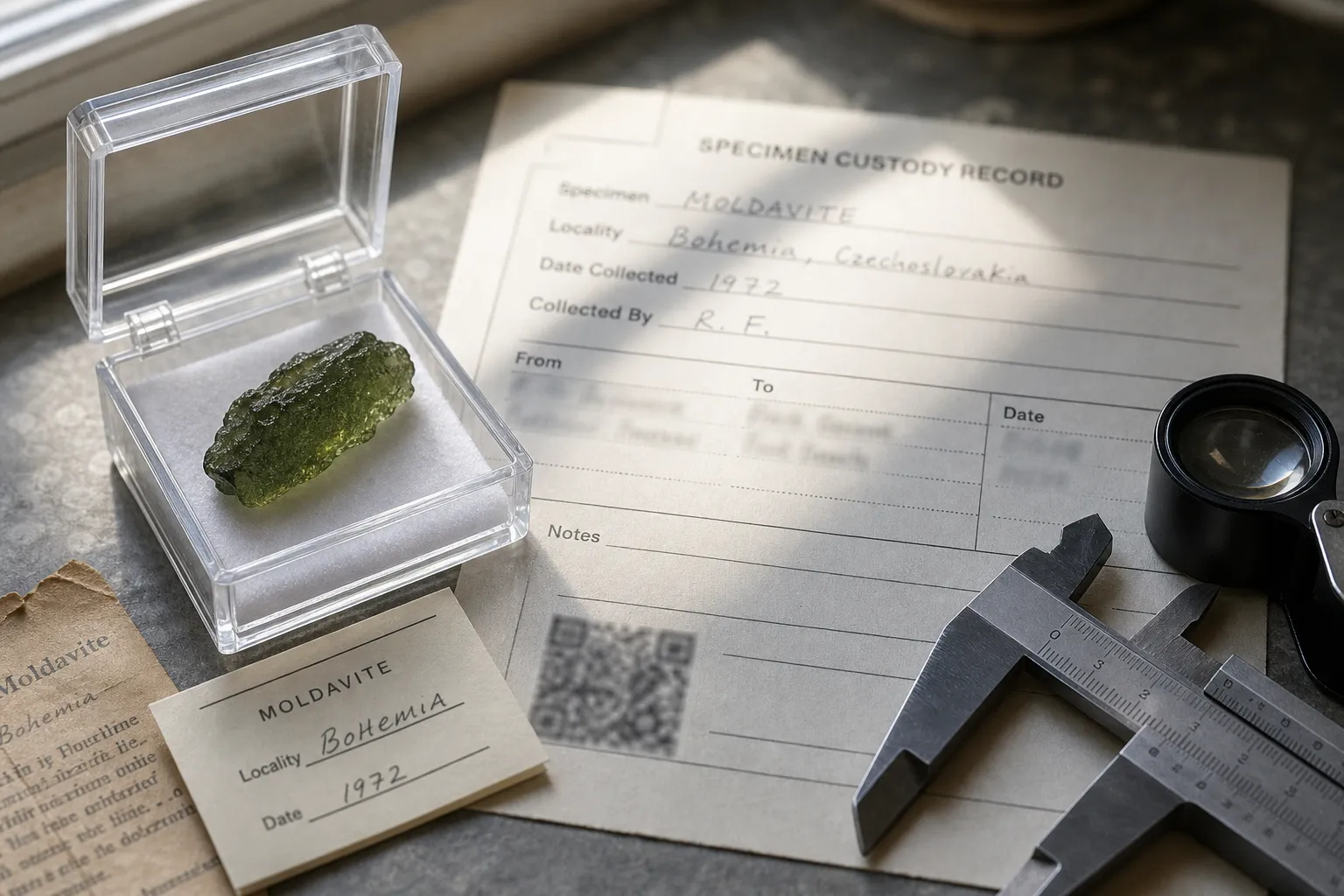
A moldavite listing can show a photographed surface, a claimed locality, a dramatic origin story, and a polished line about ethical trade. Blockchain-Verified Sourcing may add a useful layer: a time-stamped record of claimed custody, movement, or supporting documents.
That matters because it can make a provenance story harder to rewrite quietly. But it does not prove that a tektite is authentic, ethically sourced, exploitation-free, legally handled, fairly priced, or spiritually meaningful.
The direct answer is narrow: blockchain can help preserve a sourcing claim. It cannot make the claim true by itself. Its value depends on what was entered, who checked it, what documents are attached, and whether the record can be compared with the specimen, the seller’s paperwork, and appropriate authentication methods.
broader context
Moldavite context note
This narrower page makes more sense after the broader moldavite archive page.
What Blockchain-Verified Sourcing Can Help With
For moldavite and other tektites, the strongest use of Blockchain-Verified Sourcing is practical record discipline. It may help organize a circulation history: collection, transfer, storage, export, wholesaling, cutting, mounting, or retail sale.
A useful record does not just say “ethical tektite” or “from a reliable source.” It shows what is being tracked and when the claim entered the chain. A buyer can then ask sharper questions:
- Is the record attached to one specimen, a parcel, a retail order, or a general seller claim?
- Who entered the information, and what did that person or system actually verify?
- Are readable documents attached, or is the record only a badge or short label?
- Does the record follow the tektite through cutting, resale, mounting, or later handling?
- Is the claimed history specific enough to compare with the specimen and seller paperwork?
This matters because provenance is not one simple thing. Tektite provenance documentation may refer to origin, custody, ownership, route, paperwork, or seller narrative. A blockchain record may preserve one part of that story while leaving other parts uncertain.
A dated record is better than a floating phrase. A connected paper trail is better than a loose claim. The record still does not replace collector judgment.
What It Cannot Prove
The common mistake is treating a verified record as if it verifies the object itself. It does not.
A blockchain entry can record that someone described a stone as moldavite. By itself, it cannot confirm that the specimen is natural impact glass, that it came from the stated locality, or that its surface, inclusions, shape, and handling history match the claim. Tektite authentication methods still belong to material review, document review, and seller accountability.
It also cannot prove ethical conduct. A record may use wording such as “ethical tektite sourcing” or “responsible source,” but those phrases need support beyond the timestamp. Who defined the standard? What labor, land-access, export, compensation, or handling questions were checked? Was any part independently reviewed? Without that detail, the phrase remains a claim.
The same caution applies to exploitation-free claims. The wording is stronger than most casual documentation can carry. To evaluate it, a buyer would need clear definitions, transparent participants, supporting records, and a way to see what was actually checked.
Nor does blockchain documentation prove value. A traceable circulation history may interest some collectors, but it does not automatically make a tektite more important, more desirable, or more fairly priced.
Spiritual interpretation needs the same separation. Some readers approach moldavite through transformation symbolism, but that belongs to personal or cultural meaning. A blockchain record can document a claimed route. It cannot verify an effect.
How to Read the Record
The better buyer question is not “Is it on a blockchain?” It is: “What part of the claim does this record actually support?”
Start with the tracked object
If the record follows a parcel, it may not prove that the exact specimen in front of you stayed attached to that history. If it follows a finished pendant, it may begin only after cutting or mounting. If it follows a seller’s inventory batch, it may show circulation history without resolving individual authenticity.
Look at the first entry
A chain is only as strong as its origin point. If the starting record depends on an unsupported seller statement, later entries may simply preserve that statement in a more formal way. That can still help with accountability, but it does not create independent proof.
Check the attached materials
Look for attached documentation: invoices, collection notes, transfer records, export paperwork, photographs, lot numbers, or other materials that can be compared over time. If the blockchain entry contains only a badge, slogan, or single claim, it gives the buyer little to inspect.
Follow continuity through handling
Tektites may move from collector to dealer to cutter to jeweler to retail buyer. Lot numbers can change, stones can be mixed, and finished items can separate from their original parcels. A careful record makes those transitions visible.
Finally, compare the record with the specimen. Surface texture, weight, shape, damage, workmanship, and authentication context still matter. A tidy record attached to a questionable object should not settle the question.
The record supports review. It should not end review.
Claim Language That Needs Care
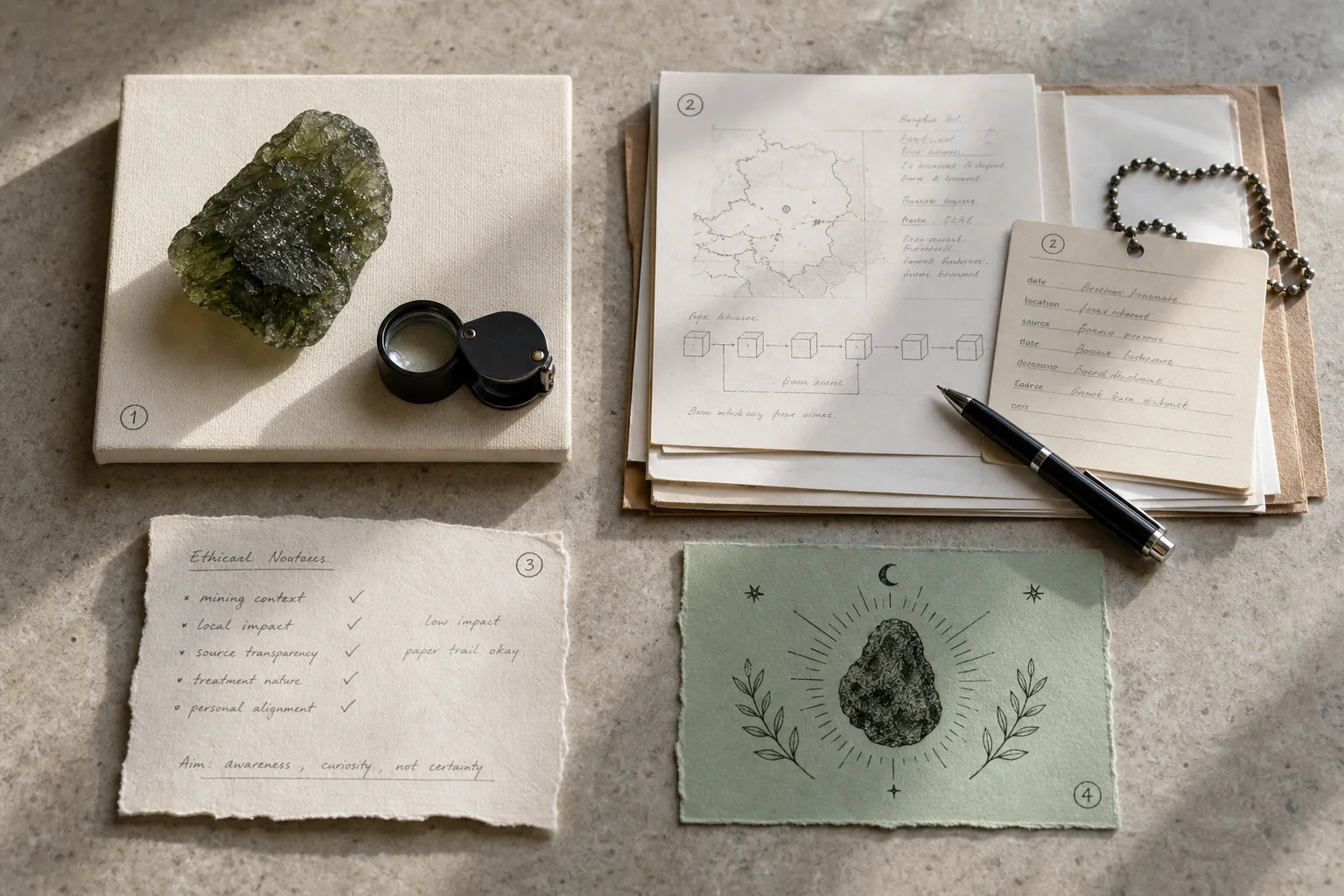
The words around a tektite often carry more certainty than the evidence can support. Blockchain sourcing limitations become clearer when modest documentation language is kept separate from sweeping conclusions.
Cautious language sounds like this: “The seller provides a dated sourcing record,” “the record appears to preserve a claimed custody chain,” or “the listing includes provenance documentation for review.” These statements describe what exists without pretending it proves everything.
Stronger language needs stronger support. Terms such as “ethical tektite,” “exploitation-free,” “fully verified,” or “guaranteed origin” should make a careful reader slow down. Not because every such claim is false, but because each one asks the documentation to carry a heavier burden.
“Ethical supply-chain verification” should identify what was checked, who checked it, when it was checked, and what remains outside the review. Without that structure, the phrase can become a polished substitute for evidence.
Useful follow-up questions
- What does “ethical” mean in this listing?
- What does “exploitation-free” exclude, and how was that checked?
- Does the blockchain record begin at collection, wholesale, jewelry production, or retail sale?
- Can the seller connect the record to this exact specimen?
- Are there separate authentication materials, or only provenance language?
A careful seller can explain the limits of a record. An overconfident seller may treat the record as a shield against ordinary questions.
A Practical Boundary for Ethical Tektites
The available material for this page does not include public reference links, confirmed case studies, firsthand reviews, or authoritative external sources that would support broad claims about blockchain systems, moldavite trade practices, labor conditions, legal compliance, or authentication outcomes. That limitation matters.
So the safest answer is procedural, not conclusive: use blockchain-verified sourcing as one checkpoint in a wider review.
It may help you see whether a seller preserved a claimed circulation history. It may help you compare dates, ownership transfers, batch records, and attached paperwork. It may make casual story-changing more visible. Those are useful functions.
But the word “verified” has levels. A platform may verify that a record exists. A seller may verify that a document was uploaded. A third party may review some part of the chain. A buyer still needs to ask what was actually checked.
For moldavite, collector literacy depends on keeping categories separate. Geology concerns what the material is. Provenance concerns where the item is claimed to have been and how it moved. Ethics concerns human conduct and trade conditions. Symbolic meaning concerns personal interpretation. Blockchain documentation may touch provenance. It does not automatically solve the rest.
A reasonable buyer standard is simple: the more serious the claim, the more specific the evidence should be.
When the Record Deserves More Weight
A blockchain sourcing record deserves closer attention when it is specific, connected, and modest.
Specific
It identifies the specimen or lot clearly enough that a buyer can understand what is being tracked.
Connected
It links to documents, photographs, transfer details, or other reviewable materials.
Modest
The seller does not use the record to claim more than it can support.
It deserves less weight when it is vague, late, or decorative. Vague records do not say what was checked. Late records begin only after the important sourcing questions have already passed. Decorative records function more like a badge than a trail.
Even an imperfect record can still help if it reveals gaps. A partial circulation history can show where tracking stops. A batch-level record can show where individual specimen tracking is absent. A seller’s plain explanation of those limits may be more useful than a perfect-looking label with no detail behind it.
This is the practical importance of blockchain-verified tektites: not certainty, but friction. A better record can create friction against vague storytelling, careless relabeling, and unsupported claim language.
It gives the buyer something to inspect. It does not give the buyer everything.
Bottom Line
Blockchain-Verified Sourcing can be important for moldavite and tektite buyers when it preserves a clear, dated, reviewable record of claimed provenance or circulation history. It is most useful as part of ethical tektite documentation when the seller explains what was recorded, who entered it, what supporting materials exist, and where the record begins and ends.
It should not be treated as proof of authenticity, ethical conduct, exploitation-free sourcing, legal compliance, fair value, or spiritual effect. Those claims require different evidence, and the supplied research set for this page does not support broad conclusions in those areas.
The careful path is narrower and stronger: inspect the specimen, read the documentation, question the claim language, and let a blockchain record support only the part of the story it can actually show. Provenance can guide collector judgment. It should not replace it.