Interpretation and evidence boundary
Gender Polarity and Tektites: Balancing Your Dominant Energy Field
A moldavite specimen may hold personal meaning within a spiritual practice, but the available evidence does not show that wearing or holding it compensates for gender energy, balances a dominant energy field, increases empathy, or improves spiritual receptivity.
broader context
Moldavite context note
This narrower page makes more sense after the broader moldavite archive page.
The direct answer
Some practitioners interpret moldavite through a polarity framework: a person who identifies with more directive, outward, or “masculine” qualities may use the stone as a reminder to notice receptivity, intuition, or inward attention.
That is a symbolic use, not an established geological, psychological, hormonal, or measurable energy effect.
The clearest way to understand gender energy compensation is to separate three layers: what the specimen is, what the polarity framework means to you, and what the available evidence can support.
What Gender Energy Compensation Means
The phrase gender energy compensation generally describes an attempt to create a felt balance between contrasting qualities. Depending on the tradition, these may be called masculine and feminine energy, active and receptive energy, outward direction and inward awareness, structure and fluidity, or assertion and empathy.
Within this language, a dominant energy field may describe a recurring personal pattern. Someone might feel strongly task-focused, controlling, analytical, or action-oriented and choose a symbolic practice that draws attention to patience, listening, uncertainty, or receptivity. Another person may understand the same pattern differently. These categories are not standardized across spiritual communities.
Moldavite can become a personal symbol in that process. Its unusual appearance and impact history may prompt reflection on change, openness, or balance. That interpretation can be meaningful without proving that the specimen changes a person’s energy field or produces a predictable emotional result.
“I use moldavite to reflect on receptivity” describes a personal practice. “Moldavite balances masculine and feminine energy” makes a broader external claim that the supplied evidence does not establish.
How Moldavite Fits the Framework
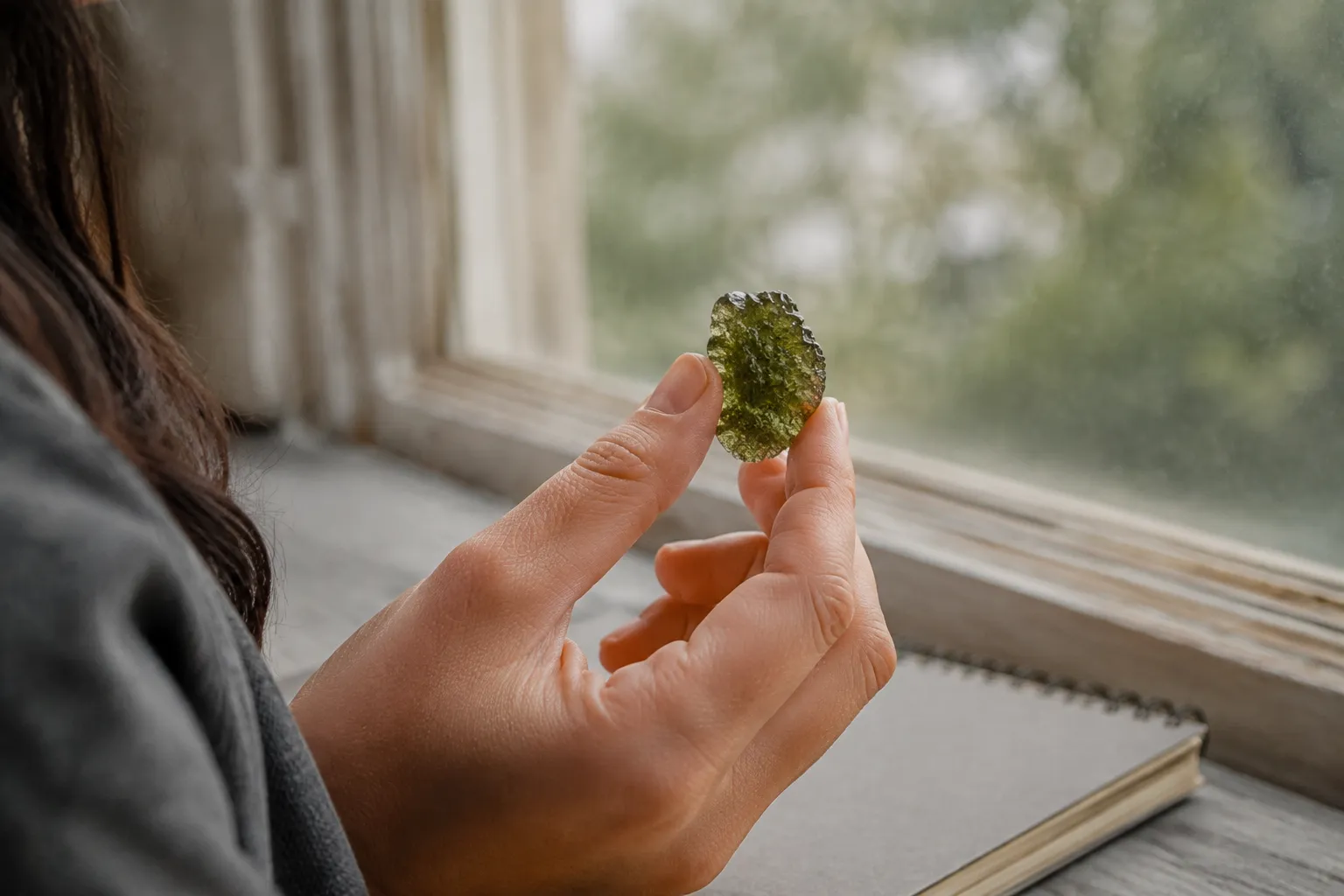
Before assigning symbolic meaning to a green, glassy specimen, it helps to identify the material itself. Tektites are natural glasses associated with impact events, as described by Encyclopaedia Britannica and the Smithsonian National Museum of Natural History.
Moldavite is commonly discussed within this impact-related natural-glass context. Its geological identity explains why collectors consider features such as glass-like appearance, surface texture, locality, formation history, and provenance. Those are geological and collector questions. They do not establish a metaphysical mechanism.
A dramatic origin story can encourage dramatic spiritual language, but impact history is not evidence of gender polarity, spiritual field balance, empathy, or receptivity. The material fact and the personal symbol can coexist without being treated as the same kind of fact.
“This tektite has a geological identity, and I assign it a symbolic role in my own reflection.”
That wording leaves room for personal meaning while keeping the evidence boundary visible.
When Field Balance May Be Personally Useful
A gender polarity and moldavite practice is most coherent when used as a reflective framework rather than a promised intervention. The stone may serve as a physical reminder to pause and ask what “balance” means in a particular situation.
- Am I acting from habit, or choosing my response deliberately?
- Do I associate strength only with control or constant action?
- Have I left room for listening, uncertainty, or receptivity?
- Am I using “masculine” and “feminine” as loose symbolic labels, or treating them as fixed traits?
- Does this framework help me observe myself, or does it make me feel confined by a category?
These questions concern interpretation. They do not require the assumption that the specimen emits a measurable field or changes a person’s internal state.
The same symbolic role could be assigned to another object, ritual, or reminder. That does not make the practice meaningless; it clarifies where the meaning comes from. A personal spiritual practice can provide language for reflection without functioning as an established method for changing health, personality, hormones, emotions, or psychological conditions.
The terms spiritual receptivity and empathy also need care. A reader may use them to describe a desired attitude, such as listening more closely or noticing another person’s perspective. They should not be treated as guaranteed effects of wearing moldavite. The supplied material contains no testing or documented consensus establishing those outcomes.
What Changes the Interpretation
The meaning of gender energy compensation depends at least as much on the framework the wearer brings to the practice as on the stone itself.
The polarity model is not universal
Masculine and feminine energy categories are not universal definitions of identity, behavior, or wellbeing. They may be meaningful in one spiritual setting and unhelpful in another. A person does not need to fit a binary model to explore qualities such as action, receptivity, structure, sensitivity, or empathy.
This framework should not be used to decide someone’s gender, diagnose a personal problem, or judge whether a person is psychologically balanced. It is a subjective vocabulary. Treating it as a fixed rule can turn a reflective tool into a restrictive label.
“Dominant” does not mean defective
Calling one pattern dominant does not show that it is excessive or wrong. A person may seek balance because a situation calls for a different response, not because an internal deficiency has been identified.
For example, someone might use moldavite as a reminder to slow down before making a decision. That is a chosen reflective exercise. It is different from claiming that the specimen will automatically correct an imbalance.
The intention may matter more than the object
If someone reports that holding or wearing a specimen helps them pause, the available evidence cannot determine whether that response comes from the material, the ritual, expectation, attention, or another part of the experience. The supplied references do not document a tested method for separating those possibilities.
That uncertainty does not invalidate private meaning. It limits how broadly that meaning can be presented.
Authenticity is a separate question
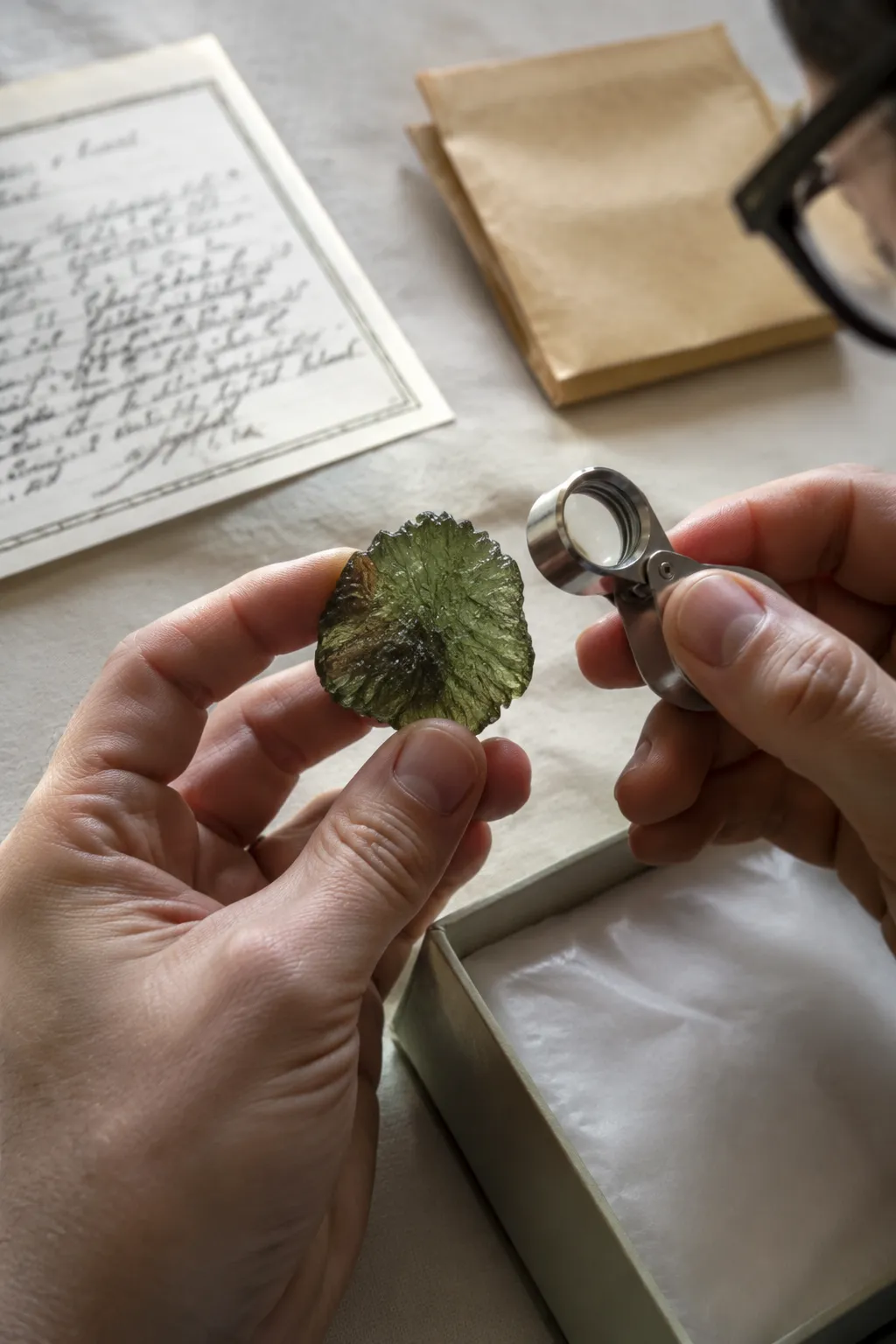
A spiritual interpretation cannot confirm that a piece is genuine moldavite. Geological context and symbolic association do not replace attention to specimen traits or provenance. A single photograph, unusual color, or intense personal impression is not enough to establish authenticity.
This page does not provide an authentication procedure, and the supplied research does not support one. Keep provenance before certainty: consider the material claim independently before building a symbolic reading around it.
Common Confusions
One confusion is treating natural origin as metaphysical proof. Because tektites are associated with impact events and moldavite has a distinctive geological history, some readers may assume that the material must produce an equally distinctive energetic result. Geological descriptions do not support that conclusion.
Another is treating practitioner language as scientific or clinical terminology. “Field balance,” “receptivity,” and “compensation” can communicate subjective experience within a spiritual community. They are not established medical, hormonal, psychological, or geological categories.
A personal result also cannot automatically be generalized. Someone may find a ritual meaningful, but the supplied material contains no verified wearer reports or testing that would justify saying moldavite reliably creates the same experience for others.
Finally, balance should not mean suppression. A reader does not need to reduce assertiveness, ambition, sensitivity, or emotional openness to satisfy a polarity model. The more useful question is whether the language supports freer reflection. If it creates pressure, fear, or dependence on an object to resolve an internal state, the framework may no longer be serving that purpose.
Limits of Metaphysical Claims
The page evidence supports moldavite as a tektite-related natural glass in a geological context. It does not support claims that wearing moldavite balances a dominant energy field or produces predictable changes in empathy, receptivity, emotional regulation, hormones, or health.
The National Center for Complementary and Integrative Health provides general terminology for distinguishing complementary or spiritual practices from evidence-based health claims. It does not evaluate moldavite specifically or determine the meaning of an individual’s private practice.
“Moldavite is part of my personal practice for thinking about polarity and openness.”
A claim that exceeds the available evidence would say:
“Moldavite will compensate for my dominant energy and create a measurable balance.”
The first describes meaning. The second presents a predictable outcome that the supplied sources do not establish.
A Bounded Way to Use the Idea
If gender energy compensation is useful to you, keep the practice observational and voluntary. Identify the quality you want to reflect on, describe it in language that does not define your identity, and treat any response as personal interpretation rather than confirmation of a universal mechanism.
Before wearing or holding a specimen, you might ask:
- What quality am I noticing today?
- What would balance look like in this particular context?
- Am I observing a feeling, or making a conclusion about the stone?
- Is this practice helping me remain open, or making me depend on an object for certainty?
There is no supplied evidence for a required wearing schedule, placement, quantity, or method. A symbolic practice does not need to become a dosage-like routine or a test of personal worth.
Moldavite’s impact history can remain part of its symbolism without becoming proof of spiritual power. Its geological identity, the specimen’s authenticity, and the wearer’s interpretation are separate layers. Keeping them separate leaves room for personal meaning while preserving collector judgment and page evidence.