Moldavite Zen
home / moldavite verification value / The Geology Enthusiast's Guide: Exploring Tektites & Decoding Reports
A 2026 Collector's Educational Guide

The Science of Tektites: Understanding Material Origins

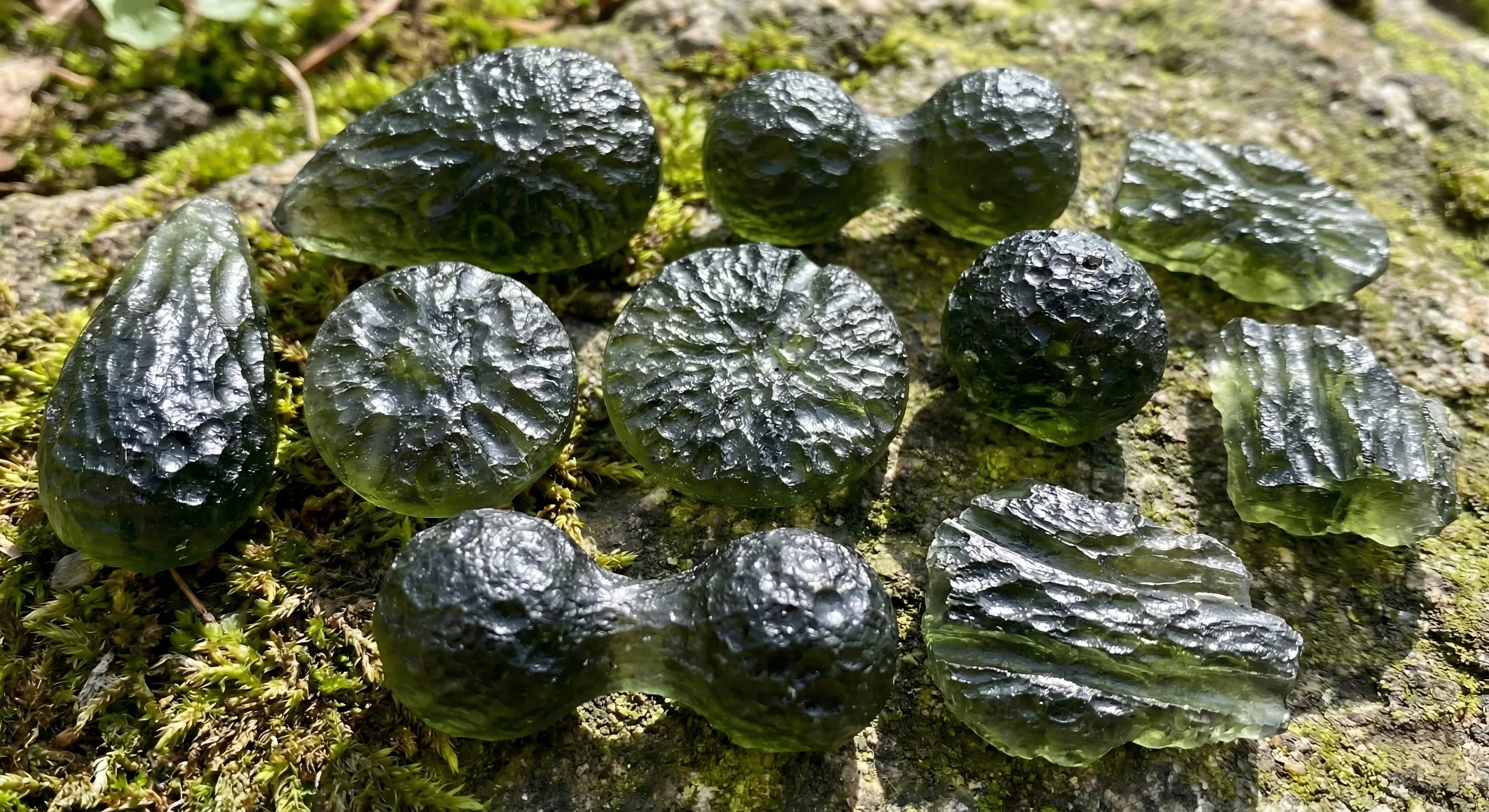
I remember the first time I held a genuine piece of Besednice moldavite. It didn't feel like glass. It felt like frozen violence. The deep, forest-green shards carried the exact aerodynamic flow lines of a liquid cooling at hypersonic speeds fifteen million years ago.

As geological interest has exploded, the market has been flooded with industrial glass masquerading as extraterrestrial impactite. Stop relying on smartphone macro photos. If you want to study these specimens, you must learn the physical chemistry of the material. A real tektite has a distinct, high-pitched clink when tapped gently against a tooth—a sound entirely deadened in lead-doped synthetics. The surface tension, the internal pressure, the chaotic inclusion patterns; these are things a factory in a verified global hub cannot easily replicate.

This interactive laboratory is built from a decade of field experience. We will strip away the mystical jargon and focus entirely on measurable geology. You will simulate a 10X loupe inspection, calculate hydrostatic specific gravity, and learn why a piece of paper means nothing without Raman spectroscopy data.

The Virtual Optics Lab

Examine the internal structure. Synthetic makers use hydrofluoric acid to fake the outside texture, but the inside remains dead glass. Use the tools below to alter your viewing conditions.

Natural Tektite Structure

Under normal conditions, exhibits a deep, natural forest green color.

Manufactured Glass Structure

Chemically doped glass may appear identical to the naked eye.

Veteran Insight: The Anatomy of Lechatelierite & Fluorescence

The ugly truth about optical inspection is that your eyes will lie to you if you do not know exactly what to anchor your focus on. Most beginners grab a cheap jeweler's loupe, squint at a stone, see some bubbles, and assume it is real. Stop doing this. A generic bubble means absolutely nothing. Industrial glass manufacturing processes trap spherical gas bubbles constantly.

What you are actually looking for is lechatelierite. This is not just a "scratch" or a "bubble." It is a high-temperature fused silica glass inclusion. When the meteorite struck the quartz-rich sands of the Bohemian region, the heat instantly melted the silica. As it was ejected into the atmosphere and rapidly cooled, these silica melts were stretched into chaotic, twisted, wire-like formations. Under a proper 10X triplet loupe (do not use a single-lens magnifier, chromatic aberration will distort your view), lechatelierite looks like frozen, microscopic worms or stretched taffy. It is deeply chaotic. Industrial synthetics poured into molds settle evenly; their internal landscape is dead, featuring perfectly round, static bubbles born from steady cooling.

The trade-off of optical inspection? It requires immense patience and ideal lighting. You cannot do this in a dimly lit room. You need a harsh, direct LED pinpoint light transmitted directly through the stone to illuminate the internal structures against the dark body color.

The Ultraviolet Trap

The UV light test is widely misunderstood. People assume a natural tektite should glow. It shouldn't. Genuine moldavite is fundamentally inert under both Long-Wave (LW) and Short-Wave (SW) ultraviolet light. The matrix is just silica and aluminum oxides with iron trace elements. Iron actually quenches fluorescence.

However, here is the friction point: sometimes a genuine specimen will exhibit faint, patchy fluorescence in its deep crevices. Why? Because over millions of years, local clay and soil rich in organic material or calcite have compacted into the eroded texture. The dirt is fluorescing, not the glass. Conversely, heavily doped modern synthetic glass—especially those manufactured using uranium or specific manganese blends to achieve that 'perfect' green hue—will often scream back at you with a chalky, unnatural neon green or blue glow under UV. It is a rapid disqualifier, but an inert reading does not automatically guarantee a natural origin. Always cross-reference your optical findings.

The Physics Lab: Specific Gravity Calculator

Specific gravity (SG) exposes what the eyes cannot see. Natural silica tektites generally have an SG between 2.32 and 2.40. Heavily lead-doped synthetic glass exceeds this range.

Note: Wet weight must logically be less than dry weight due to buoyancy.

Formula: Dry / (Dry - Wet)
2.34
Consistent with Natural Tektite (2.32 - 2.40)
Reality Check: The Flaws of Hydrostatic Testing

Specific Gravity testing is brilliant in theoretical physics but an absolute nightmare in a practical home laboratory setting if your methodology is sloppy. The formula is straightforward: divide the weight of the stone in the air by the difference between its weight in the air and its weight suspended in water. This gives you the density relative to water.

Here is the reality check: if you are testing a small specimen under 3 grams, stop bothering with standard digital scales. Capillary action and the surface tension of the water pulling on the wire you use to suspend the stone will introduce a margin of error so massive that it renders the SG calculation useless. A 0.05g error on a 2g stone will completely throw your reading outside the 2.32 - 2.40 window, falsely failing a genuine piece.

To execute this properly, you must use an analytical balance scale calibrated to 0.001g. Furthermore, veteran geologists use a specific trick: add one single drop of clear dish soap to your distilled water beaker. This breaks the surface tension of the water, preventing the liquid from "climbing" your suspension wire and adding false wet weight to your reading.

The trade-off here is clear: SG testing is incredibly cheap compared to buying a digital refractometer, but it is highly susceptible to human error. Also, be aware of the "lead trap." Early Chinese synthetic iterations were heavy lead-crystal glass, which failed SG tests instantly by coming in at 3.10+. However, modern manufacturers have adjusted their silica fluxes. While rare, some advanced synthetic green glasses now hit an SG of 2.41, dangerously close to the natural threshold. Never rely on Specific Gravity as an isolated metric.

Anatomy of Geological Documentation

A self-printed Certificate of Authenticity is an illusion. Click the document on the left to load the breakdown of scientific terminology used in standard laboratory testing.

Specimen Data Card

Mineral Group: Tektite / Impactite

Mass: 15.2 Grams

Refractive Index (RI): ~1.49

Microscopic Obs: Lechatelierite present; elongated gas vesicles.

Fluorescence: Inert (LW & SW UV)

Click document to view analysis of these terms.

Educational Breakdown

Click the document on the left to reveal the breakdown of scientific terminology.

The Paper Illusion: Lab Reports vs. Marketing Fluff

Let us be entirely blunt: a piece of paper that says "Certificate of Authenticity," signed by the person who sold you the stone, holds zero scientific weight. It is a marketing prop designed to pacify anxious buyers. True geological verification does not care about fancy gold foil stamps; it cares about reproducible data.

When you review documentation for a significant specimen, you are looking for an independent Gemological Laboratory Report (from entities operating with standards similar to GIA or SSEF). These reports do not use subjective terms like "beautiful" or "guaranteed real." They provide hard, physical science metrics.

The core metric you must look for is the Refractive Index (RI). Natural moldavite has a relatively narrow RI window, typically hovering around 1.48 to 1.54, averaging near 1.49. Why does this matter? Because cheap synthetic glass often utilizes heavy metallic oxides (like lead) to lower the melting temperature and increase malleability for the molds. Adding lead drastically spikes the Refractive Index, often pushing it to 1.57 or higher. A digital refractometer reading immediately exposes this chemical doping.

However, the limitation of a lab report is the disconnect between the paper and the physical object. How do you prove that the specific report belongs to the rock in your hand? Weight matching is the first line of defense. A report stating a mass of 15.21g must match your calibrated scale exactly. Beyond that, advanced laboratories are now embedding physical nano-tracers or using detailed photogrammetry mapping to create a "digital twin" of the stone's unique surface topography, ensuring the document cannot be bait-and-switched to a synthetic replica.

Scientific References & Further Reading

  • Gemological Institute of America (GIA). "Tektites and Impact Glasses: Identification and Properties." Gems & Gemology. Provides comprehensive data on Refractive Index and microscopic inclusions. (Educational Source)
  • Mindat.org. "Moldavite Mineral Data." The Hudson Institute of Mineralogy. Detailed physical characteristics, chemical composition metrics, and crystallographic data for silica tektites. (Educational Source)
  • Meteoritics & Planetary Science Journal. "Geochemistry of Bohemian Massif Tektites." Academic literature detailing the formation temperatures required to generate lechatelierite structures during meteorite impacts. (Educational Source)
Pillar Report Thumbnail

Return to Main Report

Moldavite Market Intelligence & Forensic Verification | 2026 Report

AUTH_SIG_VERIFIED
ENCRYPTION_ACTIVE

Investigator Profile

Hi, I’m Emily Carter, a long-time crystal researcher and writer with a special focus on Moldavite and high-vibration tektites. For over a decade, I’ve studied the geological origins and spiritual interpretations of rare stones, combining scientific literature with mindful, experience-based insight. This blog is where I share what Moldavite has taught me about transformation, awareness, and inner alignment.

Moldavite enthusiasts
Access Full moldavite geology origins Database