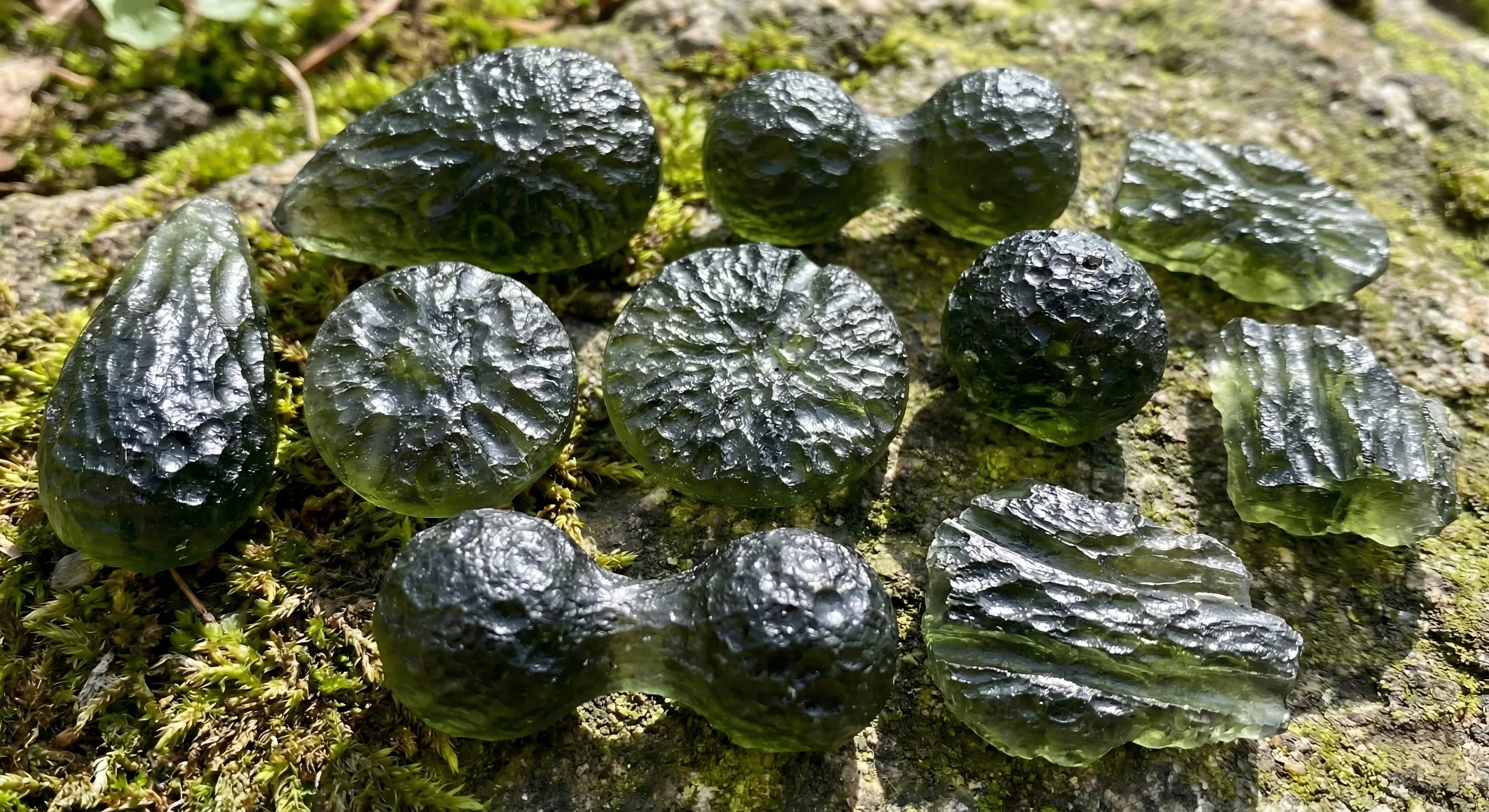
SET Geological Attributes
Micro (0.5g)
Cliff Threshold (20g)
Museum Grade (50g+)
Stop treating tektites like generic quartz. By 2026, the era of casual surface collection in Bohemia has flatlined. We are dealing with a finite, geologically exhausted impact glass that requires rigorous structural profiling, not just a casual glance.
I have handled thousands of rough moldavite pieces since the late 1990s. Back then, you could walk the freshly plowed fields of South Bohemia after a heavy rain and pick them up like common river pebbles. They felt cold, strangely lightweight compared to standard terrestrial stones, and covered in a stubborn, sticky clay that stained your fingers a deep, iron-rich rust color.
Today, the narrative pushed by mainstream crystal vendors is sanitized. They show you back-lit, ultrasonically cleaned specimens suspended in pristine acrylic boxes. The ugly truth? A proper Besednice "Hedgehog" feels downright dangerous in the bare hand. The acid-etched spines are sharp enough to snag the ridges of your fingerprints or draw blood if gripped too aggressively. Cleaning a raw, field-extracted piece is a nerve-wracking nightmare. You cannot scrub it. A stiff nylon brush will snap the delicate lechatelierite-infused ridges instantly, degrading a museum-grade specimen into a compromised fragment in seconds.
There is a severe trade-off in the moldavite community right now: aesthetics versus structural integrity. Many newer collectors demand flawlessly clean stones, completely devoid of the Moravian soil that birthed them. To achieve this, commercial preparators often resort to harsh chemical baths—sometimes mild hydrofluoric acid dips—to burn away stubborn dirt. This artificial "cleaning" physically alters the micro-texture, stripping away the natural matte patina that took fifteen million years to form. If you are handling a piece that looks uncomfortably glossy and feels entirely smooth on its ridges, you aren't holding pristine geology; you are holding a chemically compromised stone. Stop demanding perfection. True geological specimens carry the grit of their extraction.
Forget linear progression. The rarity of tektites operates on an aggressive, unforgiving exponential curve. A 30-gram smooth river-tumbled drop holds far less geological significance than a pristine 8-gram deeply sculpted Besednice.
The public fundamentally misunderstands the 20-gram cliff. They look at a 10-gram piece and assume a 20-gram piece is simply twice as rare. This is a severe analytical failure. Tektite distribution follows an aggressive power law. As molten silica splashed out from the Ries crater impact 15 million years ago, the ejecta cooled rapidly in the upper atmosphere. Physics dictates that larger aerodynamic blobs fragment under thermal stress and atmospheric friction long before hitting the soil. A surviving, intact 20-gram specimen is not an anomaly; it is a statistical miracle.
Let us look at the reality of mechanical extraction in the Chlum area around 2021, before the severe regulatory crackdowns. Commercial crews were operating massive excavators, stripping away meters of topsoil to reach the moldavite-bearing gravel layers. I have reviewed the operational logs. To yield just 100 grams of commercial-grade moldavite, miners were routinely displacing and washing over ten metric tons of earth. The fuel costs, the environmental rehabilitation deposits required by the Czech government, and the sheer mechanical wear-and-tear meant that anything under 3 grams barely covered the overhead of digging it up.
There is a distinct trade-off when evaluating these larger pieces. You can easily find a massive 40-gram "block" of moldavite, but it will likely be structurally dull—a thick, dark chunk that light cannot penetrate, completely lacking the delicate lacework etching that makes the glass famous. Conversely, a highly etched 10-gram piece is visually spectacular but lacks the gravitas and absolute rarity of mass. The holy grail—a 30-gram piece with deep, chaotic etching and intact edges—is practically non-existent outside of private vaults. When evaluating a specimen, do not blind yourself with mere scale. An enormous fragment is still just a fragment. The true scarcity index heavily penalizes heavy stones that have suffered modern excavator damage (fresh, shiny conchoidal fractures) compared to ancient, naturally etched geological terminations.
Moldavite is a strictly non-renewable geological anomaly. The interactive field simulation demonstrates how aggressive human extraction, driven by global demand, has pushed this impact glass toward absolute commercial depletion.
Hover over markers to view geological status.
The romanticized image of the lone Bohemian farmer finding a green gem in his potato field died decades ago. By 2018, the situation in the forests around Chlum and Besednice had degraded into an ecological crisis. I witnessed the aftermath of illegal night-mining operations firsthand. Organized syndicates would enter the protected pine forests at 2 AM with silent, battery-operated excavators and high-pressure water pumps. By dawn, they had left behind massive, gaping pits—some five meters deep—creating lethal traps for local wildlife and fundamentally destabilizing the root networks of century-old trees.
This destruction forced the Czech Ministry of the Environment's hand. The legal permitting process became draconian, and rightly so. Today, any legitimate commercial extraction requires millions of Koruna in upfront ecological bonds to guarantee strict land rehabilitation. You must carefully strip the topsoil, stockpile it, extract the tektite-bearing gravel, and then meticulously backfill and replant the area exactly as it was. The trade-off here is stark: saving the Bohemian forest meant strangling the global moldavite supply. The era of cheap, abundant tektites was built on the back of unsustainable, highly destructive environmental vandalism.
Understanding this geography is crucial because "Locality" is heavily spoofed today. The famous Besednice field is completely exhausted, fenced off, and heavily monitored. Yet, you will see thousands of new pieces flooding online auctions claiming to be "Fresh Besednice." It is mathematically impossible. What you are actually seeing are lower-grade pieces from Chlum, or worse, entirely different green stones, falsely labeled to capitalize on the geographical cachet. Stop trusting digital certificates without checking the date of extraction. If someone claims a piece was pulled from Besednice in 2024, they are lying to you. The earth there has been sealed.
Visual inspection is dead. We must utilize optical microstructures, surface topology, and molecular spectroscopy to reveal the cosmic fingerprints that human foundries cannot forge.
Plunging through the atmosphere and resting in highly acidic groundwater forged incredibly complex surface pitting. Counterfeiters attempt to mimic this using pressed molds and hydrofluoric acid washes, but the resulting luster is consistently wrong—it looks wet, artificial, and structurally repetitive.
Interactive Directive: Move your cursor over the scanning area on the right to manipulate the light source. Observe the chaotic micro-shadows distinguishing natural etching from synthetic molding.
Authentic tektites conceal twisted strands of pure silica known as "Lechatelierite" alongside elongated, chaotic bubbles. Stop relying on color; look for the structural distortion of light.
The definitive non-destructive test. Genuine Moldavite's silicon-oxygen bonds produce a signature resonance peak at 460 cm⁻¹, impossible to spoof.
The counterfeit market has evolved at a terrifying pace. Back in 2018, Chinese foundries were melting down green beer bottles and pressing them into crude molds. You could spot them from across the room—the color was excessively vibrant, like green apple candy, and the surfaces were unnervingly glossy. But by 2024, the game changed. Syndicates began sourcing synthetic borosilicate glass with custom-mixed iron and chromium dopants to perfectly match the absorption spectra of authentic Bohemian tektite. They stopped using molds and started tumbling the glass blocks with industrial abrasives, followed by highly controlled hydrofluoric acid baths. This created a matte, chaotic micro-texture that effortlessly defeats casual visual inspection and standard 10x jeweler loupes.
Stop relying on photographs for authentication. I cannot stress this enough. If you are examining a piece, you must employ transmitted light and hunt for Lechatelierite. This is where the physical reality of a meteorite impact becomes your only defense. When the Ries meteor struck, it melted the local sand instantly, but not homogeneously. The pure quartz grains melted into silica glass wires (Lechatelierite) that twisted through the cooler surrounding matrix. Because pure silica has a drastically different refractive index than the surrounding iron-rich glass, these wires bend light differently. When you look through a high-powered stereo microscope, Lechatelierite doesn't look like a solid object; it looks like clear, optical distortions—like heat waves rising off tarmac—frozen inside the stone. Synthetic foundries simply cannot replicate this high-pressure, low-homogeneity cooling process in a lab without the glass shattering.
However, the trade-off with microscopic authentication is user error. Many novices confuse the parallel stretching lines of mold-pressed glass (schlieren) with genuine Lechatelierite. This is why Raman spectroscopy has become the unyielding final judge. By shooting a monochromatic laser at the specimen and measuring the inelastic scattering of photons, we analyze the vibrational modes of the silicon-oxygen tetrahedra. Authentic moldavite, due to its violent impact origin, possesses a highly strained molecular architecture that produces a distinct, broad peak at the 460 cm⁻¹ wavelength. The caveat? A portable Raman spectrometer costs upwards of $15,000, and dirty specimens can produce intense fluorescence that completely swamps the Raman signal, resulting in false negatives. The reality of modern authentication is that it is expensive, slow, and requires serious analytical training.